Fractional Savings Calculator
Salary is one line. Benefits, payroll tax, recruiting fees, and the management overhead that comes with every permanent headcount decision are the rest. Use this calculator to see the number, and what a fractional engagement typically costs instead.
No email required. Results are shown immediately.
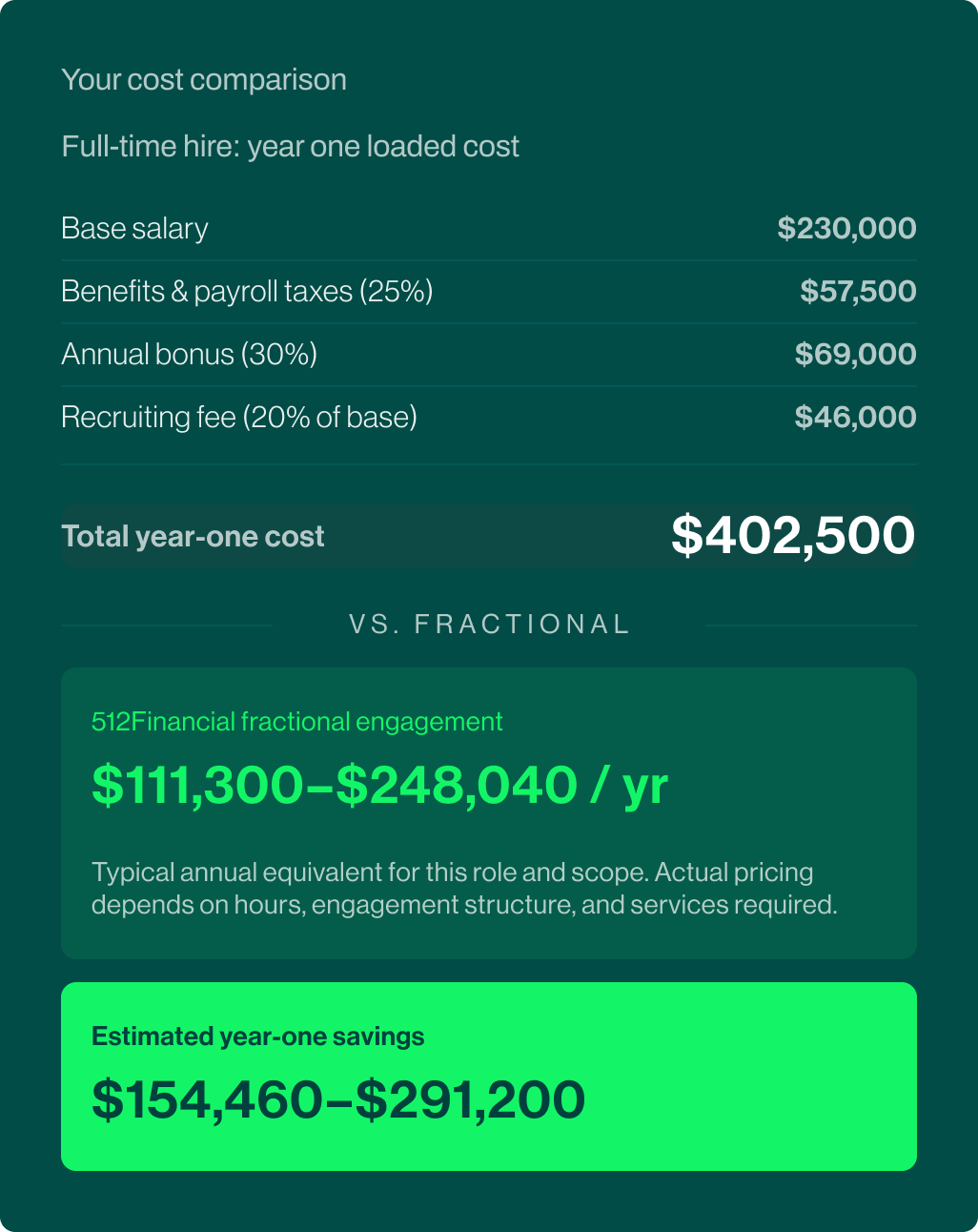
Build your comparison
Your numbers. Your role. Your actual savings estimate.
Select a service and role, then adjust the cost assumptions to match your situation. The comparison updates in real time. This tool is designed for planning purposes only. Salary benchmarks are based on US market averages for growth-stage companies and are updated periodically. Fractional engagement ranges reflect typical 512Financial arrangements and will vary based on specific scope, company stage, and hours required. This calculator does not constitute a price quote or commitment.
Ready to see a real proposal?
These estimates are based on market averages. A conversation with our team takes about 20 minutes and results in a scope and pricing range specific to your company.
What the salary number leaves out
Four costs most founders discover after the hire.
The base salary is the visible line item. The loaded cost is what that hire costs the company in year one, and it is consistently 50–70% higher. Here is where the gap comes from.
01
Benefits and payroll taxes
Employer-side FICA (7.65%), health and dental coverage, 401(k) match, and any additional employee benefits. These typically run 18–28% of base salary for a fully-loaded package at a growth-stage company.
At $180,000 base, this adds $32,400–$50,400 before a bonus is considered.
02
Annual bonus
Most senior finance and people roles carry a target bonus of 10–20% of base. Even at the conservative end, this is a meaningful addition, one that compounds against benefits and payroll taxes.
A 10% bonus on a $180,000 base adds another $18,000 to year-one cost.
03
Recruiting fee
Retained and contingency search fees for CFO, Controller, and HR Director roles typically run 18–25% of first-year base compensation. For a single hire, that's often a six-figure fee paid before the person walks in the door.
At 20% on $180,000 base, the recruiting fee alone is $36,000.
04
Ramp time and infrastructure
A new permanent hire typically takes 90–120 days to reach full productivity. During that period, leadership time, onboarding costs, and tooling stand-up all represent real cost that rarely appears in a hiring forecast.
This calculator conservatively omits ramp cost.
How it works
How we calculate the numbers in this tool.
Not everything fits the FTE model
Three of our practices work differently and cost comparisons require a different conversation.
Transaction Advisory
Due diligence, M&A readiness and quality of earnings are project-based, not headcount-based.
Transaction Advisory engagements are scoped around a specific event: a fundraise, acquisition, or sale process. The right question is what good diligence costs versus what a bad deal costs you after close.
Executive Retained Search
C-level searches run on a retained fee model, not headcount replacement.
Retained search engagements are scoped around a single, targeted hire: typically a C-level or senior leadership role critical to the company's next stage. We focus our search for the right person to take the company forward, and the engagement ends when that hire is made.
Strategic Talent Planning™
Org design and hiring roadmap work runs on retainer or project scope, not headcount replacement.
Strategic Talent Planning engagements address how a company structures itself for the next stage of growth. This is typically ahead of a funding round or major hiring wave. These are not replacing an internal hire; they are providing capability that most growth-stage companies do not have internally at all.