What a Fractional CFO Costs, and the Question That Matters More


The Short Version

Cost is the right question, not the only one
We have supported more than 150 investor-backed companies since 2022, and the first question founders ask about a fractional CFO is almost always the same. What does a fractional CFO cost? It is the right question to ask, and for most growth-stage companies the cost difference is significant. It is also not the only one. The question sitting right next to it is how much CFO capability the business needs, and when.
Most companies reach a point where they need sharper forecasting, board reporting, fundraising support, and a clearer read on how the business is performing. They need help making decisions. What they do not necessarily need is a senior executive whose only job is finance. That gap, between needing CFO-level work and needing a full-time CFO, is where the fractional model earns its place.
What a full-time CFO costs, fully loaded
When founders evaluate an executive hire, they anchor on salary. Salary is only part of the number. The loaded cost of a finance leader includes benefits, payroll taxes, an annual bonus, recruiting fees, and the ramp time before the hire is fully productive.
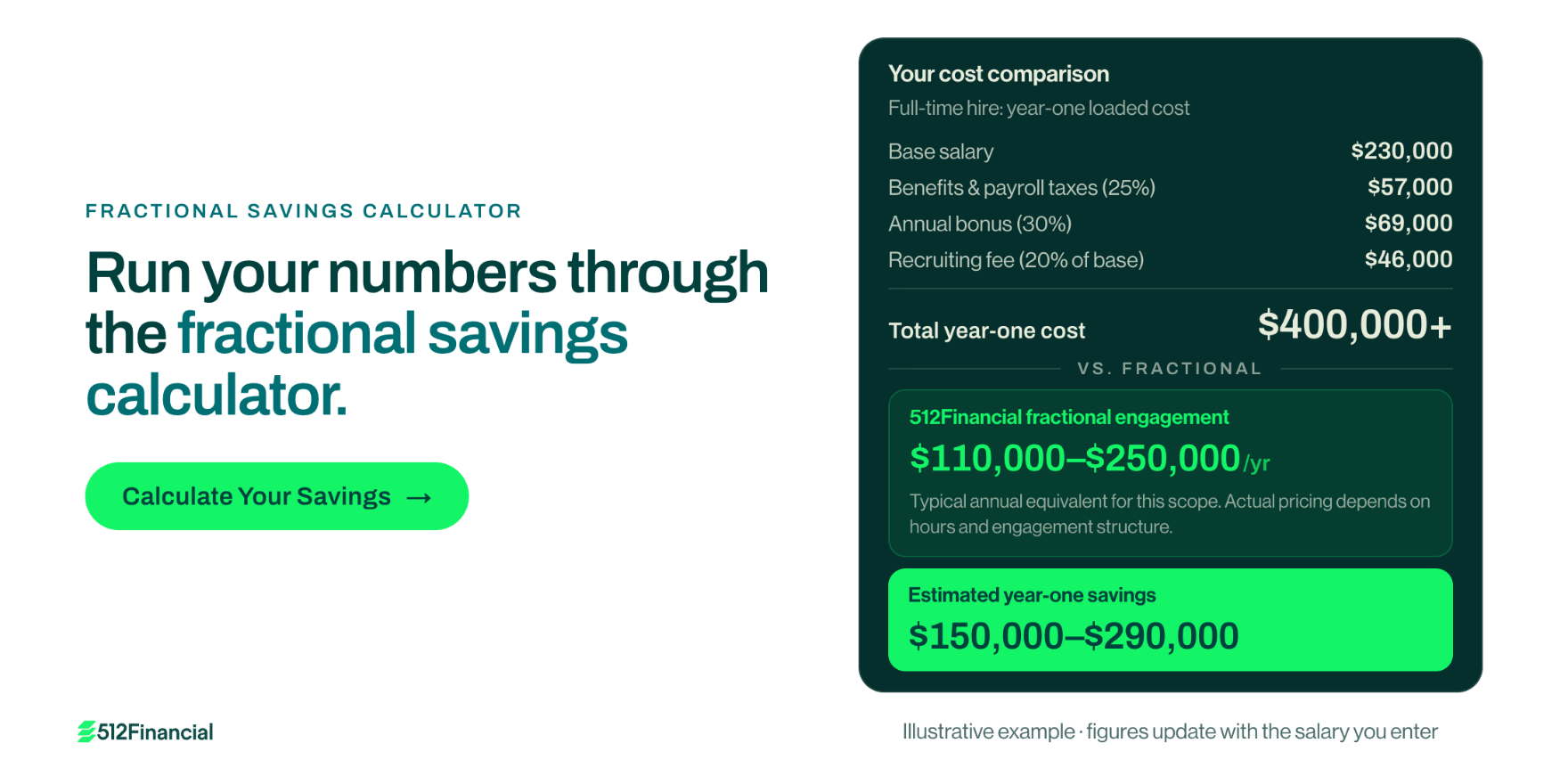
Run the math on a CFO with a $230,000 base at a growth-stage start-up. Benefits and payroll taxes add about $57,000, the annual bonus about $69,000, and recruiting about $46,000, which pushes the year-one total past $400,000, roughly 75 percent above the salary alone. That does not make a full-time CFO the wrong call. Plenty of companies need one. It does change the conversation from “can we afford a CFO” to “how much CFO do we actually need.”
And $400,000 is only the cash. A full-time finance leader joining a scaling, institutionally backed company expects equity on top of it, usually around a point, and a point of a company that keeps climbing is not a small line item. A fractional carries little to none of that. The distance between the two options is wider than the salary math shows.

What a fractional CFO costs
Companies bring in a fractional CFO when they need financial leadership but are not ready to carry a full-time executive. Engagements vary, but most relationships fall between 35 and 80 hours a month, scaled to the company’s stage, complexity, fundraising activity, and reporting requirements.
That means that a fractional CFO costs roughly $9,000 to $21,000 a month, or $110,000 to $250,000 a year, depending on where a company lands. The lightest advisory work sits near the bottom of that range, and an active fundraise or a fast-scaling year runs toward the top.

Where a given company lands depends on a handful of factors: board reporting demands, fundraising activity, the maturity of the existing finance team, planning complexity, and growth trajectory. The aim is not to replicate a full-time CFO at a discount. It is to bring in the level of financial leadership the business needs now while keeping room to change the arrangement as the business changes.
Fractional CFO vs. full-time CFO: the cost comparison
Side by side, the comparison is straightforward. A full-time CFO costs about $400,000 in year one. A fractional CFO costs $110,000 to $250,000 a year. Most engagements land 40 to 60 percent below the full-time number, with the lightest advisory work saving more and the most hands-on engagements saving somewhat less.
The exact figure moves with scope, the size of the team already in place, and how active the year is. The broader point does not move. A company can reach CFO-level leadership well before the workload, the complexity, and the investor expectations justify a full-time seat.
There is a bigger reframe hiding in that comparison. A lot of companies go looking for a CFO when only a slice of the work needs one. Forecasting, board reporting, and capital planning need CFO judgment. The monthly close and the books do not, and paying CFO rates to own them puts money in the wrong place. Price the two jobs separately and the comparison changes. Instead of $400,000 against a full engagement, you are weighing $400,000 against something like $100,000 of CFO time and $50,000 of accounting support. Match the resource to the work and you almost always land below a full-time hire, and below a fractional engagement scoped as if you needed a whole CFO.

The numbers above use one set of assumptions. Run yours through our fractional savings calculator and you can make the same year-one comparison on your own salary, bonus, and engagement level.
Fractional CFO vs. a freelancer, CPA firm, or full-time hire
Founders should also know that a fractional CFO is not the only way to get financial help, and the options at times get confused or conflated. Here is how they stack up, and where each falls short.

One distinction drives the resourcing decision. If the work you are picturing runs lighter or cheaper than a fractional CFO engagement, what you likely need is a fractional controller ($5,000 to $12,000 a month), not a CFO. Those are different jobs, owning the close and the books rather than forecasting, capital planning, and investor conversations, and aiming below the CFO range is usually a sign the CFO need is not here yet. We staff those layers too, so the honest answer is sometimes a CFO can wait.
The other flag is quality. The title is unregulated, so plenty of people marketed as fractional CFOs operate at controller or bookkeeper level with a costlier label. Vet for forward-looking work and a bench behind the individual: a freelancer, at roughly $5,000 to $10,000 a month, gives you one person’s playbook, while a firm gives you the read of everyone who has solved the problem before. We wrote about how to tell the difference in Buyer Beware: Not Every Fractional CFO Brings the Real Deal.
What a fractional CFO brings that a full-time hire can’t
While the cost difference between a full-time CFO and fractional CFO is clear, there are three intangibles that matter just as much, and none of them shows up on the invoice. Founders often think they are buying a forecast. What they are buying is someone who has seen the pattern before, who costs only what the stage calls for, and who will tell them the hard thing.
Pattern recognition
A full-time CFO spends years inside one company. A fractional CFO works across many companies at once, so a problem that is new to one resource is familiar from a dozen other experiences. You are also not leaning on one person: our CFOs often work alongside our accounting, people operations, executive search, and transaction advisory teams.
Capability sized to the work
Most companies do not need 160 hours a month of CFO leadership. They need forecasting, board reporting, cash flow visibility, capital planning, and fundraising support, sized to the stage. Accounting tells you what happened. A CFO helps you decide what happens next.
Objectivity
A fractional CFO is not protecting a permanent seat, which makes it easier to say the hard thing: the runway is shorter than the model shows, or the raise everyone assumes is close is not ready. Founders get an outside read from someone who does not depend on telling them what they want to hear.
When a fractional CFO is the right call, and when it isn’t
The common mistake is assuming the step after an accountant or controller is a full-time CFO. In practice, most companies pass through a stretch where they need forecasting, budgeting, board reporting, KPI development, and cash planning, but not a full-time executive whose only remit is finance. That stretch is where a fractional model creates the most value.
The moments that bring a company to a fractional CFO are usually concrete. We see it most as revenue moves through the $2 million to $20 million range, around a Series A or B raise, ahead of or right after an acquisition, when the business expands into a new market or product line, and when a leadership transition leaves an interim gap to cover. A full-time CFO tends to fit when complexity is climbing fast, when investor expectations require dedicated finance leadership, when several departments need ongoing executive oversight, and when the workload clearly justifies the role on its own.
Frequently asked questions
How much does a fractional CFO cost?
Most engagements run about $9,000 to $21,000 a month, or roughly $110,000 to $250,000 a year, depending on company complexity, fundraising activity, board reporting requirements, and the work underway. Most land 40 to 60 percent below the fully loaded year-one cost of a full-time hire.
How many hours a month does a fractional CFO work?
Most engagements range from 35 to 80 hours a month. Lighter advisory relationships sit near the bottom of that range; an active fundraise or a fast-scaling year pushes toward the top.
Is a fractional CFO cheaper than a full-time CFO?
In most cases, yes. A full-time CFO carries benefits, bonus, payroll taxes, and recruiting fees well beyond base salary. Depending on scope, a fractional CFO costs 40 to 60 percent less in year one.
When should a company hire a fractional CFO?
Common triggers are preparing for a raise, more demanding board reporting, accelerating growth, covering a leadership transition or interim gap, and the need for sharper forecasting and planning.
What is the difference between a controller and a fractional CFO?
Controllers own accounting accuracy, financial controls, and reporting. A CFO owns forecasting, capital planning, board communication, fundraising support, and helping leadership decide what comes next. A fractional controller also costs less, often about $5,250 to $11,700 a month, and is frequently the right fit before the CFO need arrives.
How long does a fractional CFO engagement last?
Most start at one to two years. Some are shorter, scoped to a specific stretch like a raise or a leadership gap, and many continue until the company is large enough to justify a full-time hire. Our goal is scaling our clients to the next stage, so a bringing on a full-time role is the natural progression. When our clients are ready, we help them source their full-time hire with our executive retained search practice.
When should a company move from a fractional CFO to a full-time CFO?
Usually when complexity, investor expectations, organizational size, and workload consistently justify a full-time executive whose only job is finance.
The better question
While many founders start with what a fractional CFO costs, the companies that get the most from financial leadership end up somewhere else. They ask what it costs to keep operating without it. That second question is usually the one that decides whether a business is ready for the stage in front of it.

Ready for your next stage of growth?