What the People Readiness Assessment Surfaces Before Your Board Does


The Short Version

When to Assess Your HR Practices
The first sign it’s time to take a hard look at your HR practices is often a board or employee question nobody can answer cleanly: how the option pool was sized, whether the ESOP timing is right, or which states the company is actually registered to employ people in. The People Readiness Assessment was built to find gaps like that first. We sat down with Sarah Russell and Nicole Bennett, who lead 512Financial’s People practice, to talk about what it surfaces, why they built it, and how it works.
What the People Readiness Assessment Covers
Mechanically, it’s not complicated. Two or three stakeholders complete a structured Score survey covering leave administration, payroll controls, hiring, classifications, and record keeping. Three focused Q&A sessions then go deeper, the kind where you learn how things work in practice versus how they’re written down. The findings become a written report with scored baselines, risk-ranked observations, and a phased roadmap. Most engagements run four to six weeks.

Why We Built It
Our clients move fast, and people infrastructure is usually the last thing to catch up. HR that was built for 20 people ends up carrying 80, and the hard part is knowing what to fix and in what order.
Sarah put the origin this way: the founders 512Financial works with have usually spent time assessing their finance function by the time the firm is brought in. What surprises them is what’s underneath on the HR side.
An audit flag on I-9 records. A senior hire who lasts six weeks because the comp framework is inconsistent across roles. Neither is catastrophic on its own, but both tend to surface when a company can least afford it.
What kept showing up was a familiar pattern: a company sensed something on the people side wasn’t right but couldn’t name it, and its leaders would leave a planning meeting with three different views of what was urgent.

“We all come into planning with ideas and intuition. The assessment helps bring data and concreteness to those conversations so leaders can see the same picture and plan from the same starting point.”
Sarah Russell, Director of People Strategy Practice, 512Financial
That is what changes the dynamic. Once everyone is reading the same baseline, the meeting stops being about whose read is right and becomes a question of what to do first.
That’s why we built the People Readiness Assessment. Our people operations team does this work for high-growth, investor-backed companies every day, and we wanted a faster, more affordable way to give clients that same starting point.
Three Gaps It Almost Always Finds
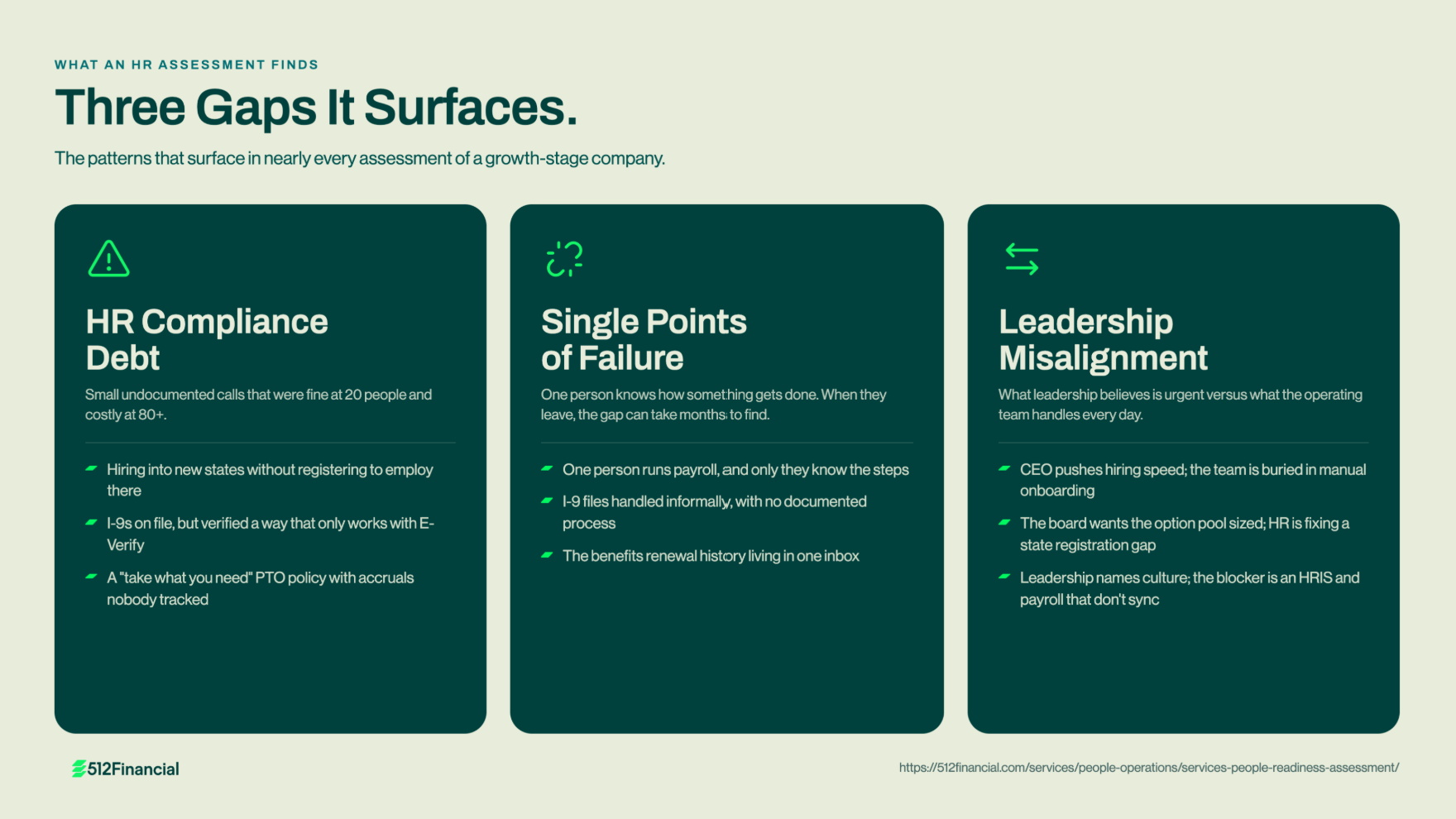
When Nicole walked through the patterns that show up in nearly every assessment, three came up repeatedly.
- HR compliance debt: These are the gaps that were manageable when the team was small but become liabilities as it scales. Leave policies that lived in someone’s head, classifications, payroll controls, the small calls made without documentation when everyone could still walk down the hall: fine at first, costly at scale.
- Single points of failure: There’s almost always one person who knows how something gets done: I-9s, an obscure benefits quirk, a contractor relationship nobody else can see. When that person goes on vacation, or leaves, the gap can take months to find and longer to fix.
- Misalignment between leadership: There often is a divide between what leadership believes is urgent and what the operating team deals with day to day. The Score survey usually shows it before the conversations do, and it’s often the most actionable thing the assessment finds.
In practice, these gaps are rarely dramatic. One recent assessment looked at a fully remote company of around 60 people that thought its HR was in order, but the assessment found a costly finding.
Every hire had a completed I-9 filed in their HRIS, so the box looked checked. But the remote verification method the company relied on is only permitted for employers enrolled in E-Verify, and the organization wasn’t enrolled. I-9 penalties are assessed per form, roughly $290 to $2,900 each; across 60 hires, that is tens of thousands of dollars at the low end and into six figures at the high end, before anything looks obviously wrong.
This hadn’t surfaced internally, and would be the kind of thing that would turn up in an audit.
“We often find blind spots that are high risk but low effort to fix. Addressing those early gives companies protection and frees them up to focus on bigger work.”
Nicole Bennett, Practice Leader, People Operations, 512Financial
What You Walk Away With
Three deliverables, all built to be used by the leadership team rather than archived:
- An executive presentation. A board-ready deck that translates the findings into language a CEO and an investor can act on. It doesn’t read like an HR report.
- A prioritized 90-day roadmap. Phased by what to fix in the first 30, 60, and 90 days, because a flat list of forty items is overwhelming and doesn’t move. A sequenced plan does.
- The top five priorities. The issues that carry the most risk or the most upside, pulled out so nothing critical gets buried in the longer report.
Where an HR Assessment Fits
The assessment is a starting point. What happens next depends on what surfaces, and that varies a lot by company.
Some teams use it to onboard a new Head of People who needs a baseline to work from. Some run it ahead of a Series B raise to make sure HR won’t surface badly in diligence. Some treat it as the foundation for a PEO exit. And some come away with a list of items they can tackle internally, looping us back in only for the harder pieces.
Others build it into how they grow. One construction company that had scaled toward 1,000 employees through acquisition started with an assessment to size its people function against the business it had become, which led to a modern HRIS and hiring a new senior people leader. Now it runs the same read on every company it acquires, assessing the incoming team, so the compliance and integration work is mapped before the two organizations merge and not discovered after.
That instinct matches the data. In a study of acquisitions by Aon, three of the top five drivers of deal failure are people-related, from culture and integration to workforce issues diligence missed.
Because we operate as a fractional partner, we can stay involved at whatever level makes sense after the assessment with ongoing monthly support, a focused project to rebuild a function, or nothing further, with the report as the team’s guide to execute on their own.
“Some companies want to move fast on everything. Others want to phase things in. The assessment helps us meet them where they are.”
Sarah Russell, Director of People Strategy Practice, 512Financial
Signs It May Be Time to Assess Your HR Practices
The trigger moments we see most often:
-
 Headcount growing faster than the systems behind it
-
Expansion into new states with new compliance maps
-
Exiting a PEO or implementing an HRIS
-
A new People leader stepping in and needing a baseline to work from
-
Preparing for a Series B or other round where people ops will surface in diligence
-
A board question or audit flag that exposed a gap nobody had a clean answer for

When to Bring in Fractional HR to Support
The companies that run an assessment early tend to find the same gaps as the companies that wait. The difference is what it costs them. A missed state registration caught at 40 employees is a cleanup task. The same gap found in a data room during diligence becomes a negotiating tactic.
The stakes only climb from here, with each new investor, every jump in headcount, every new state you operate in. Running an assessment before that happens is the faster, lower-cost way to get to a prioritized list of what to fix, and it gets you there without overbuilding an HR function ahead of where the company is.
Learn more about the People Readiness Assessment.

Ready for your next stage of growth?